Clef

Für EliseLudwig van Beethoven

Learn the pieces you love faster and keep them.

Clef hears every note over MIDI and re-tests each bar from memory right before you’d forget it. So what you learned last month is still under your fingers today.

No credit card requiredSign up with Google

The problem

You put in the hours, and the piece still slips away.

From adult pianists, in their own words:

  • After two weeks

    “I am shocked at how quickly I'll forget bits of a song that, just two weeks ago, I had finally worked up to performance level.”

    Piano World forums · 40 years of playing
  • After three weeks

    “After 3 weeks, I tried playing the old songs again but my fingers just didn't know which key to press.”

    Piano World forums
  • After four years

    “Almost 4 years in, and I can't play a whole song through if someone asks me to.”

    r/pianolearning

It isn’t your memory, and it isn’t your age. Forgetting actually happens on a predictable schedule, but most of us just don’t practice that way.

How Clef works

Practice that runs on your memory’s schedule.
No method to study, no plan to maintain. You sit down and play. Clef tracks every bar and brings each one back right before it would slip.

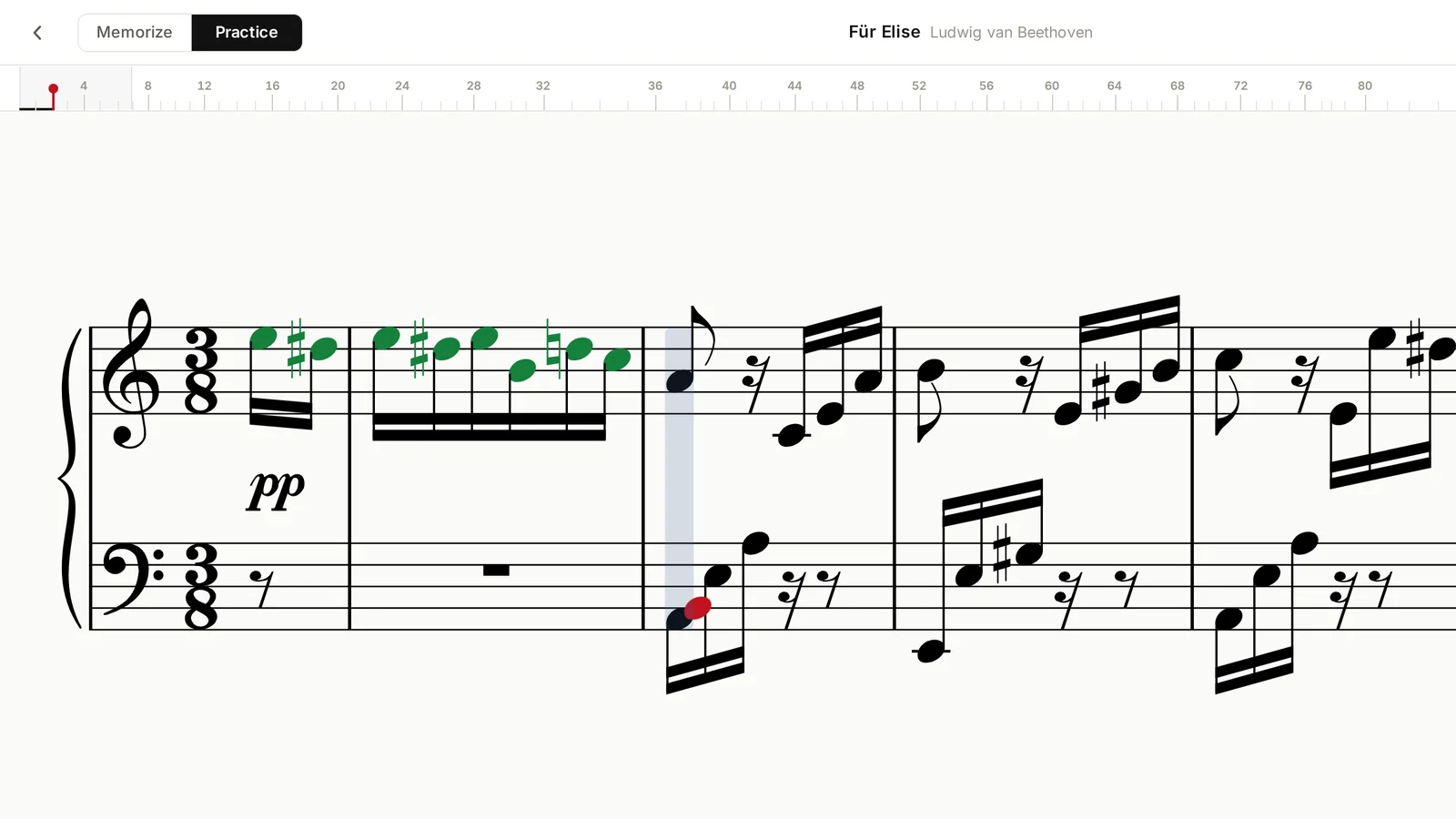
  1. Practice view: right notes green, a wrong note flagged red

    The score responds to you

    One cable from the piano you already own to your computer, and the sheet music on screen responds to your hands. Right notes turn green and the cursor moves forward. A wrong note is marked in red at the exact spot. Clef reads the keys you press, not a microphone. No guessing whether you got it right.
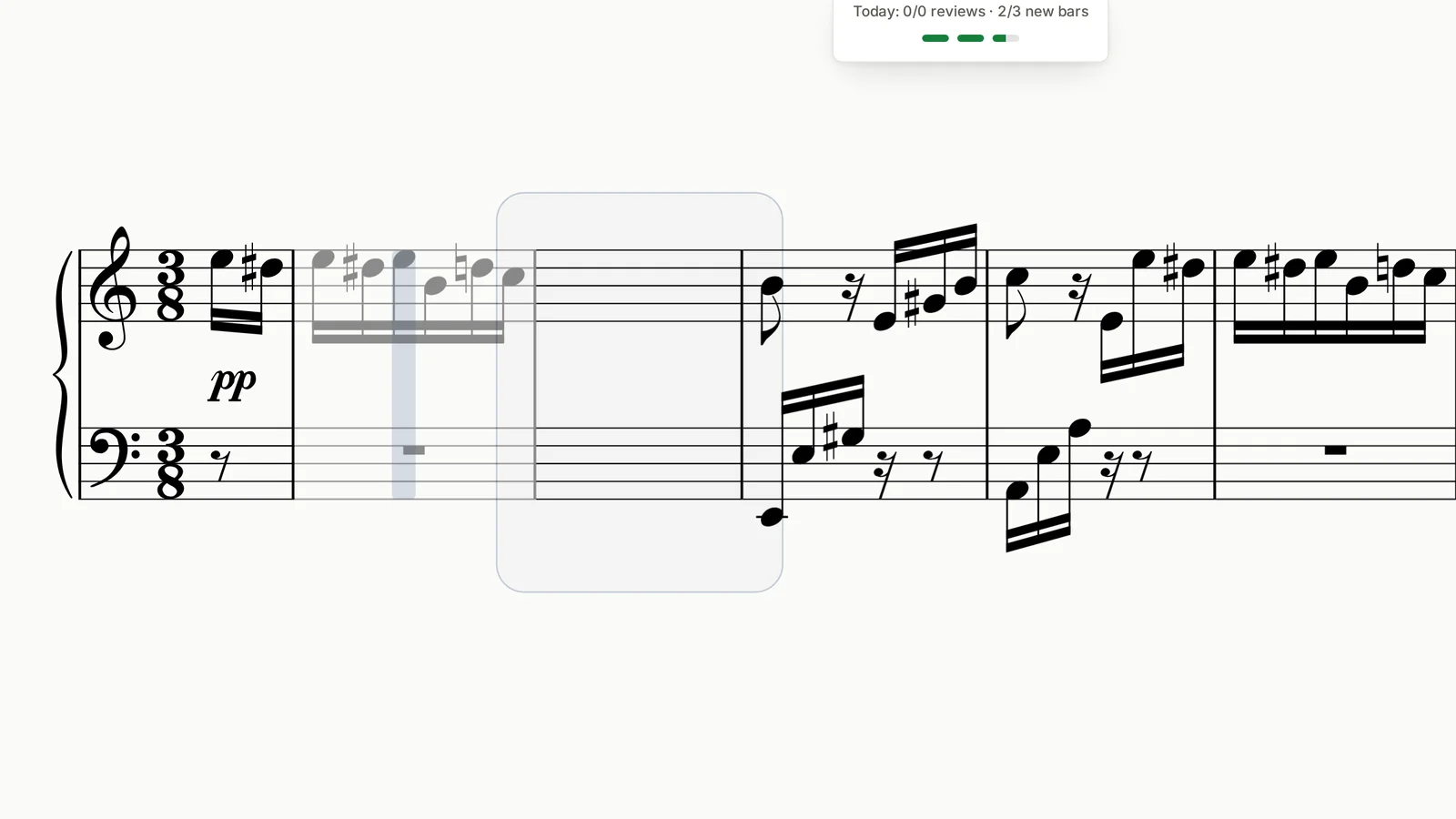
  2. Memory review: cue bar visible, next bar played from memory

    Memorize one bar at a time

    Clef shows the bar before as a reminder, and you play the next bar from memory. It tells you instantly whether you had it. New bars get a gentle first pass with the score visible.
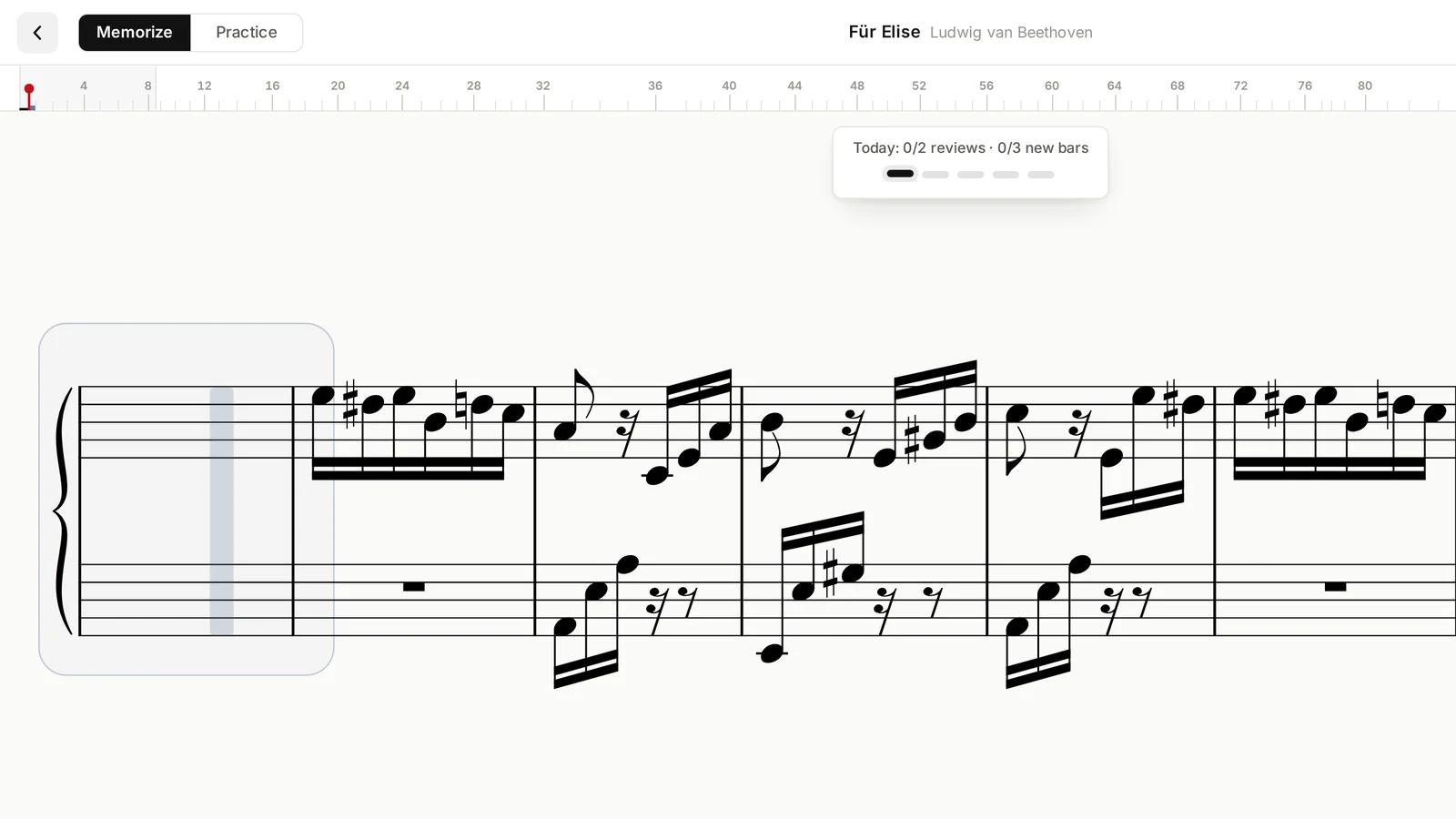
  3. Due reviews: bars scheduled back just in time

    Each bar comes back before it slips

    The proven spaced-repetition schedule, applied to your hands: every memorized bar is re-tested right when it matters. Miss one, and you re-practice it until it runs clean twice in a row.
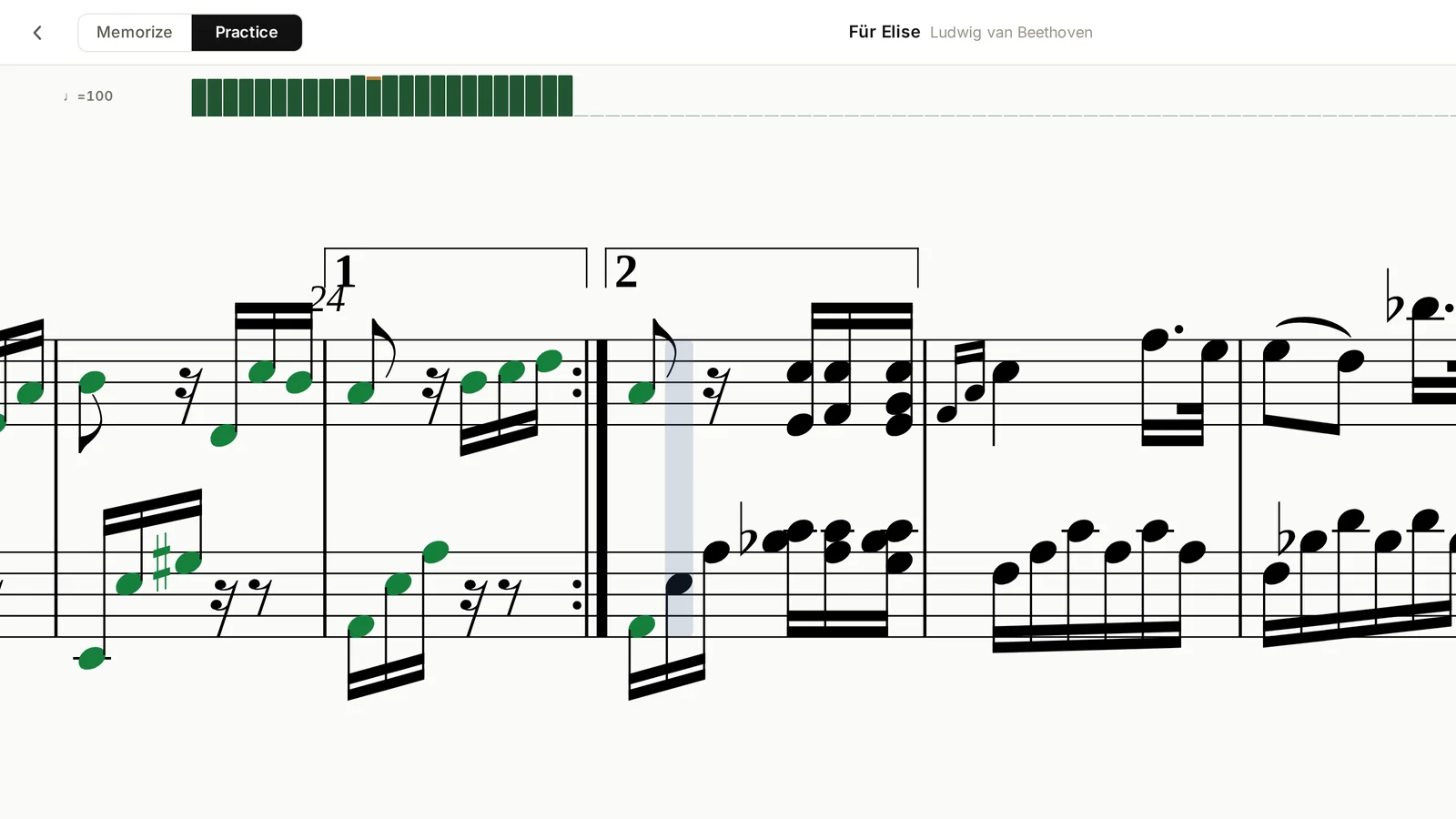
  4. Tempo map: every bar's clean tempo, at a glance

    Bring it up to speed

    Turn on the metronome and play. Clef remembers, for every bar, the fastest tempo you've played it cleanly — and shows exactly which bars are holding the piece back. When you raise the tempo, it's because you've earned it.
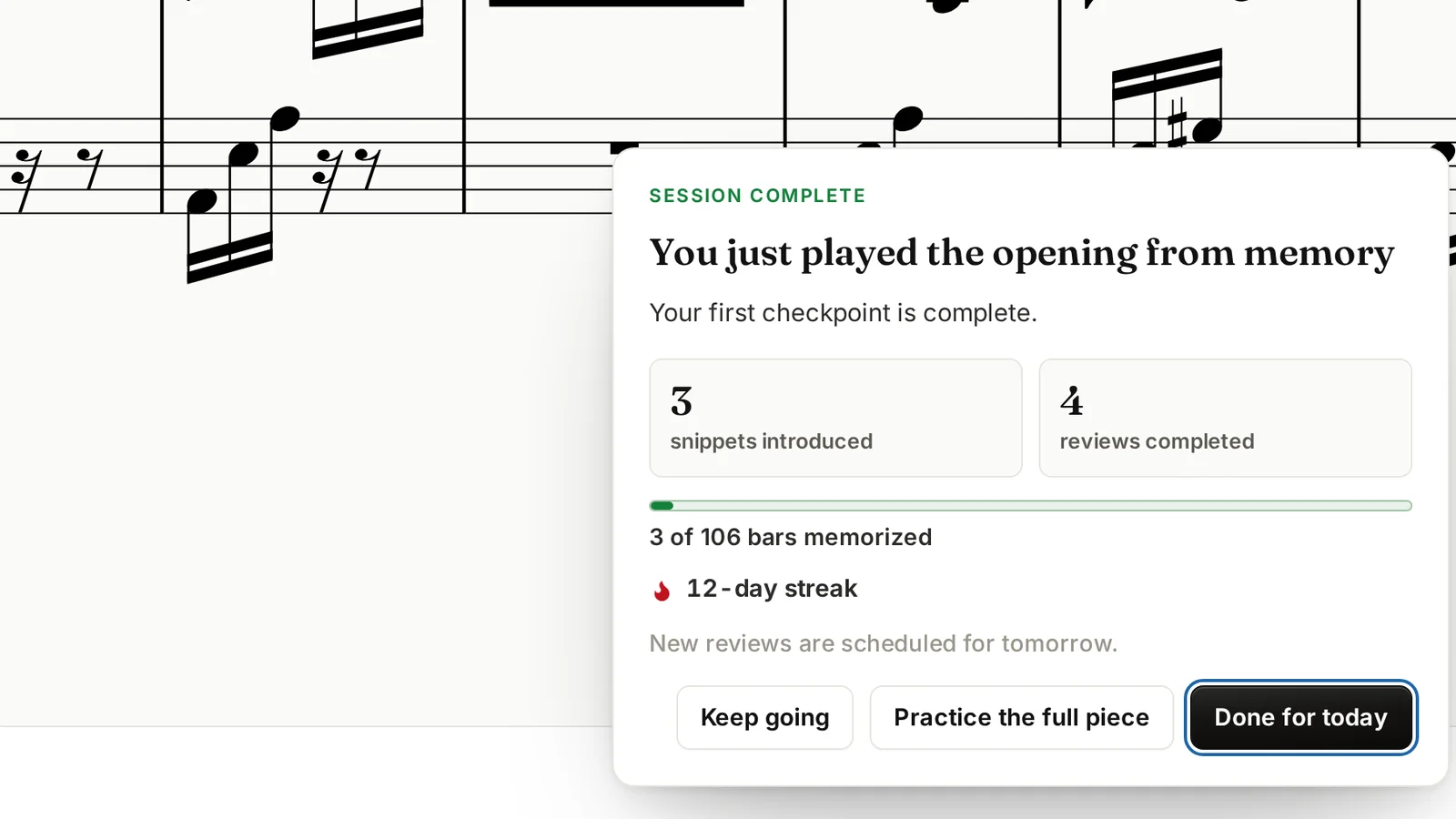
  5. Session complete: mastery meter and streak

    From fragments to the whole piece

    Every few bars, Clef has you play the whole stretch you've just learned in one run, from memory. Each stretch overlaps the last, so the bars weld together instead of staying separate fragments. Sessions are capped: a done-for-today screen, a streak, and a practice heatmap that shows the habit building.

Why it works

The method isn’t new. Applying it to piano is.

The forgetting curve was mapped by Hermann Ebbinghaus in 1885, and spacing reviews against it is one of the most replicated results in learning research. It is how medical students hold anatomy and how flashcard apps teach languages. Clef runs your repertoire on the same schedule, with MIDI as the honest judge.

Pianists already swear by each ingredient:

  • Feedback that forces you right

    “I learned the verse of “Someone You Loved” in one sitting because it forced me to get it right.”

    Pianist’s blog, reviewing a wait-mode practice app
  • MIDI, not microphones

    “Now note recognition is working perfectly.”

    App Store review, after connecting a MIDI keyboard
  • Spaced repetition, by hand

    “Practice the piece every second day, then increase the days in between.”

    r/piano, advice for keeping memorized pieces

Clef puts all three into one practice loop.

The founding cohort

Join the first fifty.

Why so few? Every requested piece is curated by hand and every support email is answered by one person. The cap keeps both true.

Founding bonuses

  • A direct line to the founder

    Founding feedback visibly shapes what gets built next.

  • Founding piece priority

    Your catalog requests go to the top of the curation queue.

Daniel Dratschuk, the founder of Clef

“I’m Daniel. I built Clef after one season too many of losing pieces I’d already learned. It runs on my own practice every day, and every support email lands in my inbox.”

Daniel Dratschuk · founder, Essen, Germany

The founding rate

$9/mo

Locked for as long as you stay. $19/mo standard after the cohort fills.

What's included

  • Per-note MIDI feedback: green when right, red where wrong
  • Every practice take recorded — listen back any time
  • A tempo map that remembers how fast you can play each bar cleanly
  • Memory reviews scheduled on the forgetting curve
  • The full curated catalog, plus request for new pieces
Start Free Trial

Plain terms

  • A 14-day free trial. No credit card required; if you do nothing, it simply ends.
  • Monthly billing. No surprise annual charge, ever.
  • A reminder email before the trial ends.
  • Cancel in two clicks from inside the app.
  • 30-day no-questions refund on your first paid month.

Questions before you start

Do I need a special keyboard?

No. Any digital piano or keyboard that connects to a computer works, and almost every instrument made in the last twenty years does. Usually it is one cable, the same kind a printer uses, from the back of the piano to your laptop. (Your manual may call this the MIDI or “USB to Host” port.) Clef reads the keys you actually press instead of listening through a microphone, which is why it can tell you exactly which note was wrong. Acoustic pianos without that connection are not supported yet. And if you want to feel the feedback before connecting anything, there is a short demo that runs right in this browser with no piano at all.

What computer and browser do I need?

A laptop or desktop running Chrome, Edge, or Firefox. Clef runs right in the browser with nothing to install, but the browser has to be able to talk to your piano, and Safari cannot. There is no mobile or tablet app yet: on iPhone and iPad, no browser can reach a piano at all, so that part is out of Clef's hands for now.

What skill level is this for?

Late-beginner through advanced. If you can read sheet music and play simple pieces hands-together, Clef can take it from there. Its job is the memorization, not teaching you to read notes from scratch.

Is Clef only for memorizing?

No. Practice mode is a full practice surface: the score grades every note you play, you can start from any bar, and there is a built-in metronome. Playing with the metronome on feeds a per-bar tempo map, so Clef remembers the fastest tempo you have played each bar cleanly and shows which bars are holding the piece back. You always know what to drill and when a tempo raise is earned. Memorization is the layer that makes all of that work stick.

How big is the catalog?

Small and growing. Every piece is engraved and checked by hand so the notation and the note-by-note grading are exact. The range already runs from beginner Bach and the Petzold minuets through Für Elise, Clair de Lune and the Moonlight Sonata, up to Chopin's études and La Campanella. If the piece you love is not there, request it from inside the app: right now most requests are engraved and published within a day, often within a few hours.

What if I already take lessons?

Clef complements lessons rather than replacing them. It's the daily practice engine between sessions, making sure what your teacher assigns actually sticks, so you show up having truly memorized it.

How much time do I need?

As much or as little as you have. Clef opens on the bars that are due, so a spare ten minutes is real practice instead of ten minutes deciding what to work on. If you want to sit down for two hours, it will keep up with that too.

What happens after the 14-day trial?

Nothing, unless you choose to subscribe. You start the trial without entering a card. To keep practicing after the 14 days you add a payment method and continue at $9 a month. If you do nothing, the trial simply ends and you are never charged. You will get a reminder email before it does.

Will my price go up later?

Not yours. Clef is $9 a month now, and it stays $9 for as long as your subscription is active. The price will rise for people who join later, once the catalog and the app have grown. That change will not reach you.

Can I cancel anytime?

Yes. Billing is handled through Stripe, and you can manage or cancel your subscription from account settings whenever you like.

A repertoire you can play, any day someone asks.

That’s the whole promise: learn the pieces you love faster, and keep them. Fifty founding seats, plain terms, and the keyboard you already own doing the listening.

Start Free Trial

14-day free trial, no credit card required.

Not sure yet? Try without a piano, right in this browser.